Back to The Lab

Introducing Parasite SEO: The Curious Case of Clickout Media

Photo of Idil Woodall
Idil Woodall
SEO Specialist

SEO has always had a wild side.

For every marketer carefully improving site speed, writing genuinely useful content, and trying to earn rankings with good old-fashioned value, there’s someone else asking: “What if we just… used another website’s authority instead?”

And that, broadly speaking, is how parasite SEO was born.

Recently, the topic exploded into industry conversation because of the super bizarre story surrounding Clickout Media, a company accused of buying up trusted editorial websites, flooding them with AI-generated gambling content, replacing editors and writers with AI, and effectively hollowing them out to send gambling sites some search traffic.

The story became even stranger when investigations into the practice were temporarily removed from Google after what Press Gazette described as a bogus DMCA complaint.

Which means we now have: SEO manipulation, AI content farms, expired media brands, casino affiliate schemes, Google penalties, and allegedly weaponised copyright complaints… all in one story.

Honestly, if SEO were interesting enough to others to get its own Netflix documentary, this would already be in production.

So let’s unpack it properly: What parasite SEO actually is, why people use it, what allegedly happened with Clickout Media, and why Google suddenly seems very interested in shutting the whole thing down.

Firstly, What is Parasite SEO?

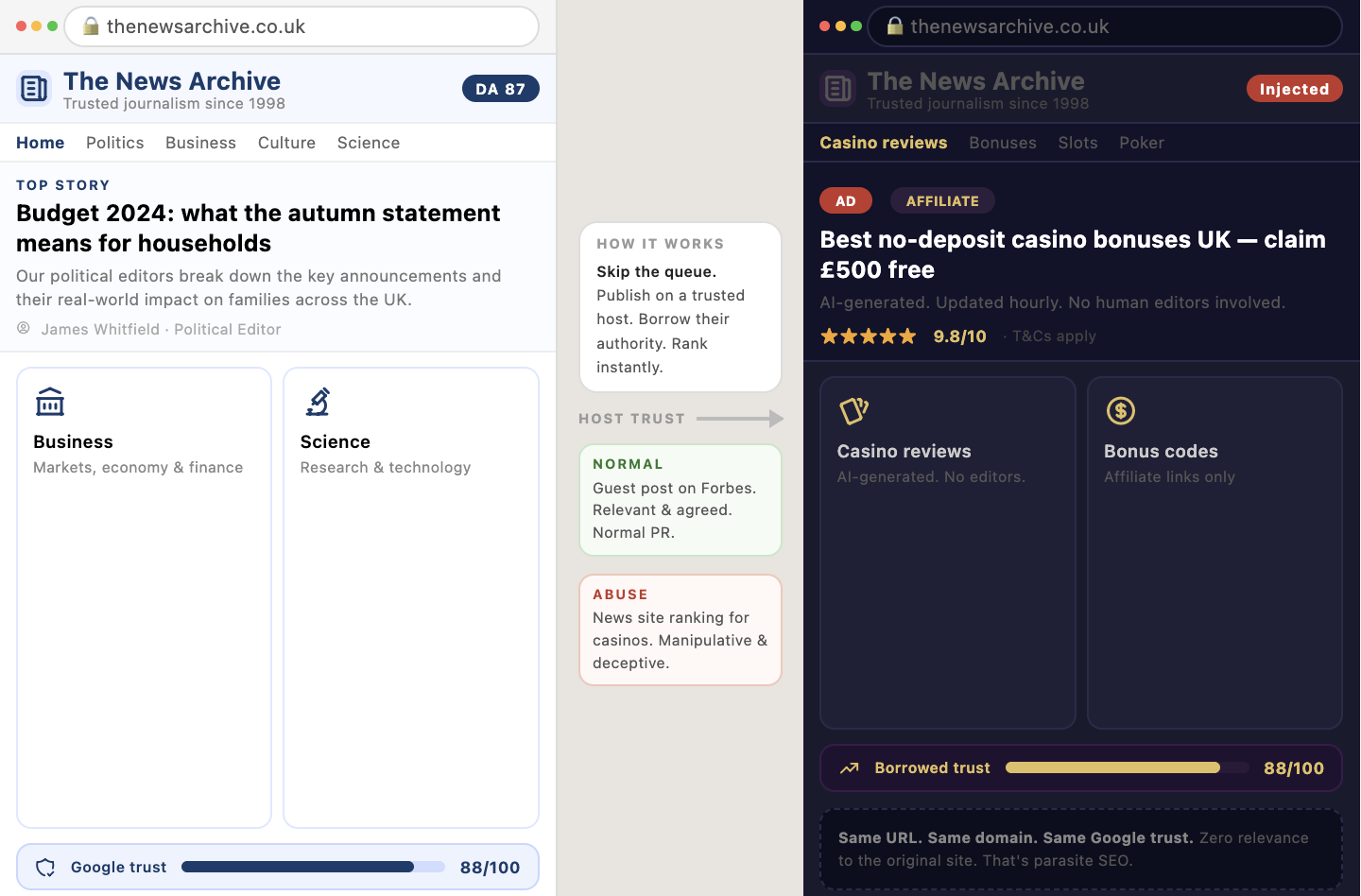
Basically, spam walked so parasite SEO could run. This type of “black hat SEO” (the darkest of black) is when someone publishes content on an authoritative website in order to exploit that website’s DA (domain authority). Within this sketchiness, they use existing search reputation and trust rather than building authority themselves.

The “parasite” part comes from the idea that the newly added content is effectively feeding off the host domain’s trust. Google, quite simply, calls it site reputation abuse.

Instead of building a new site from scratch and earning rankings over time with the tried and trusted methods of being genuinely useful to users, parasite SEO skips the queue by attaching itself to a domain Google already trusts.

That host could be: a major news site, an old publication, a forum, a university domain, a blogging platform, or a niche media brand with strong historical authority. It doesn’t seem to matter what the host's original focus was on - as long as that DA is high, it’s a prime target for internet pirates to board and plunder (sorry for the dramatics, but I’m getting into my metaphors here - this is a passionate subject for us professional SEOs!)

The logic is simple: Google trusts the domain already. So your content ranks faster. And to be fair, already exists across the internet in relatively harmless forms. For example: A finance expert writing for Forbes, a SaaS company publishing thought leadership on HubSpot, or an industry guest post on a respected publication.

We do this all the time for PR - that’s normal digital marketing.

Parasite SEO becomes controversial when the relationship between the host site and the content becomes manipulative, deceptive, or completely disconnected from the site’s original purpose.

That’s where things start getting weird.

Where Parasite SEO Crosses the Line

Google now refers to the more aggressive form of parasite SEO as site reputation abuse.

This term generally refers to publishing content at scale, specifically to manipulate rankings. At Kaweb, we’re now seeing this in the form of websites turning to AI to pump out quick, long-form blogs with little to no human editing. While this may help boost visibility and traffic in the short run, the long-term promises something different: Google says these violations will trigger manual actions and removal from Google’s index and search results. 

Let’s go back to parasite SEO, though. In this technique, third-party content exists just because the site’s authority helps it to rank and be seen, even though the content itself has little to no relevance to the publication’s original expertise or audience. 

Classic examples could include:

  • A health site suddenly publishing casino reviews

  • A local newspaper ranking for payday loans

  • A sports publication turning into a crypto affiliate machine overnight

  • A respected editorial brand is quietly becoming an SEO shell

Which, unfortunately, brings us neatly to Clickout Media, because they did all that and more.

The Clickout Media Story

In March 2026, Press Gazette published an investigation alleging that Clickout Media had bought up hundreds of trusted online news outlets and repurposed the sites into large-scale gambling and affiliate SEO operations. Clickout basically harvested “their reputations before leaving behind a ruined shell.” Nasty stuff.

According to the reporting, genuine journalists and freelance staff were replaced with AI-generated writers, editorial sites shifted suddenly to casino and crypto content, and once-respected publications became empty vehicles for affiliate traffic.

Some of the sites that were taken over included sports, gaming, and tech publications that had built years of organic authority before being transformed into something entirely different. 

The Gamer reported on one of the lost gaming sites (of which there were many). In this report, it’s noted that the site, VideoGamer, was originally founded in 2004 by two university friends, which is as authentic as it gets. To have flourished (or even survived) for two decades in the volatile video game industry is truly impressive - they focused on original interviews and excellent reporting, and had therefore earned their success. Soon after being bought up, all content writers had been fired, they’d pivoted completely to AI-generated content, and were soon de-indexed by Google - a sad end to their impressive legacy.

Press Gazette described this process as bluntly as we would: trusted sites are effectively being “harvested” for SEO value before being abandoned once Google penalties hit.

That’s the part that matters most here.

Because parasite SEO only works while Google still trusts the host. The second Google decides, “Hang on… why is this football blog suddenly ranking for offshore casinos?” the whole thing collapses remarkably quickly.

Which, according to multiple reports, is exactly what happened.

Then Things Got Even Stranger

A few days after the investigation went live, Press Gazette reported that its article had disappeared from Google’s search results following a copyright complaint filed through the DMCA system.

A follow-up article from Search Engine Land was also removed.

The complaint allegedly claimed that Press Gazette had copied another publication’s article “word for word,” despite the investigation being original reporting. In other words, someone filed a BS DMCA notice to kill the story, and for a little while, it worked.

Google later reinstated the articles, but the whole episode exposed something really important: search visibility is now deeply intertwined with platform moderation systems, legal reporting tools, AI-generated content, and reputation signals.

SEO is no longer just “keywords and backlinks.” It’s increasingly becoming information warfare with spreadsheets.

Why Parasite SEO Became So Popular

Because, quite frankly, building authority properly is hard.

Real SEO takes: time, technical work, content strategy, links, trust, brand building, and patience. Parasite SEO shortcuts all of that. Instead of asking: “How do we build a trusted publication?” the parasite SEO mindset asks: “How do we acquire one?”

And in industries like gambling, crypto, finance, supplements, and other ultra-competitive affiliate niches, the financial incentives are enormous.

According to Press Gazette’s reporting, affiliate arrangements in gambling can generate massive recurring commissions, which helps explain why some companies aggressively pursue authority-based SEO loopholes.

The issue is that the strategy often destroys the original publication in the process. Human writers disappear. Editorial standards collapse. AI content floods the site. And eventually, Google catches on.

It’s less “growth strategy” and more “SEO strip-mining.”

Google’s Crackdown on Site Reputation Abuse

Google has spent the past two years increasingly targeting this behaviour.

Makes good sense, really, since the rise of ChatGPT and its language model counterparts. Google's spam policies now specifically mention “site reputation abuse,” especially where third-party content piggybacks on trusted domains to rank for unrelated queries.

And importantly, Google seems far less tolerant of it than it used to be. 

While Google doesn’t tend to share details on decision-making, we believe this is because search is already under pressure from AI-generated spam, declining trust in results, mass-scale content production, and aggressive affiliate manipulation.

If Google lets parasite SEO dominate results unchecked, the entire usefulness of search kind of disappears. And Google knows that.

This is why many SEOs believe the Clickout situation may end up becoming one of the defining examples of Google’s modern anti-spam era.